The Lighthouse
The Horror of Isolation
It’s impossible to talk about the lighthouse without mentioning the dire and desolate nature of the setting and bleak but unique style in which the film is presented. The image of a lighthouse in of itself provides connotations of severe disconnectedness and isolation, this is only amplified by the fact that the film is completely devoid of any colour and has an aspect ratio of 1.19.1 which helps creates a sense of claustrophobia and hopelessness as aspect ratio can have a significant impact on the tone of a film shown by the quote from John Francis Mccullagh in his article for the beat.
‘The classic academy ratio can create an old-timey feel whereas the super wide anamorphic screen creates the sense of blockbusters and epic fantasy or adventure films.Yes, Certain colour grading techniques can emphasize these moods, but it starts with the ratio’
These are all stylistic choices that feel like they’re integral to the story, the aspect ratio and colour scheme doesn’t just make it look unique and feel unique but it also has a direct correlation with the nature of the character of Winslow (who is the narrative voice) as he struggles with guilt, hopelessness, a power struggle with the head lighthouse keeper Thomas Wake and the mundane nature of his job with claustrophobic aspect ratio mirroring how Winslow feels claustrophobic and trapped in his own life as its revealed he is a man who has lived many jobs and never found stability.
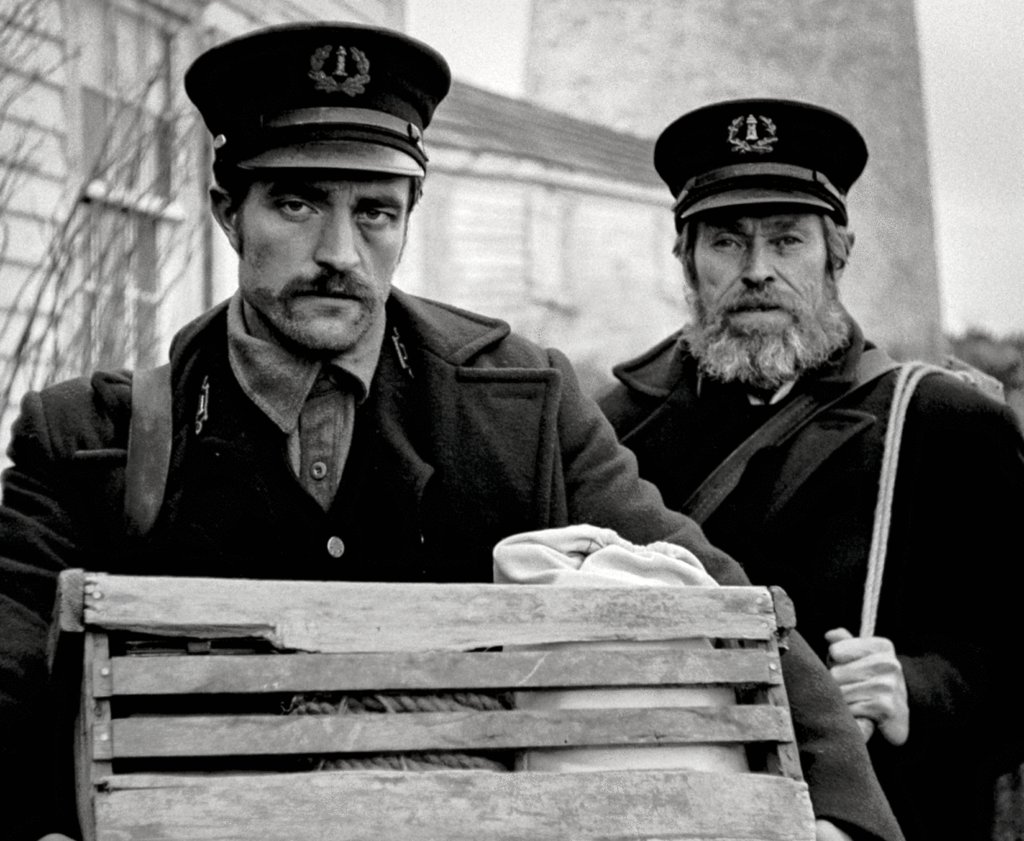
From the start it is clear that Winslow and Wake are not familiar with one another.
The film contains multiple supernatural elements throughout, with Wick believing that seagulls posses the souls of dead seamen. Winslow also has multiple encounters with sirens, a greek mythological monster. However it seems more likely that what is driving the two lighthouse keepers to insanity isn’t a supernatural influence (like there was in Eggers previous film ‘The Witch’) but rather the symptoms of extreme isolation. Loneliness can cause extreme emotional issues that include hallucinations and delusions, in 2008 clinical psychologist Ian Robbins carried out an experiment in which six volunteers were placed in sound-proofed rooms in a former nuclear bunker for 2 days in a row, all of the volunteers suffered anxiety and paranoia but perhaps most significantly when discussing the film they also hallucinated claiming they heard fighter planes and saw snakes with Robbins claiming when talking to the BBC
“The bottom line is that they felt miserable, Research has shown that happiness is not only about experiencing pleasure. You need a sense of meaning and purpose – which you lack in these conditions. And when you have a task to do, you do have that sense – even if it’s a simple task.”
While the hallucinations that come with extreme isolation may explain some of the more supernatural and superstitious elements within the film, the lack of purpose is also something that both Wick and Winslow have to battle in order to maintain sanity, they also must deal with keeping themselves occupied, the maintenance required for the lighthouse seems like it accomplishes this for the first 4 weeks, (which was how long they were supposed to be there for originally) however this quickly degenerates and both the characters slip into drinking in a vain attempt to keep their mind off of things. It has been shown that people being left alone to their own thoughts is an incredibly undesired thing, so much so that physical pain is seen as preferable. This is shown by an experiment carried about by the University of Virginia which found that when a series of volunteers were placed on their own for 15 minutes with an electric shock buzzer, more than half of the volunteers shocked themselves despite the pain because they found any form of stimulant including pain to be better than boredom, and Winslow is a character that is revealed to get bored incredibly easy, when he ‘spills the beans’ to Wake after a night of drinking it is revealed he is on the run from an incident of a previous job in which he was responsible for the death of a coworker and he stole his identity and moved away. These are the actions of an immoral man who has failed to find any kind of meaning or purpose as he left his entire life behind. The lighthouse only was only another addition to Winslow’s list of failed careers as any sign of ambition or enthusiasm he showed for the job was immediately undermined by Wick who ruled the lighthouse with an iron fist. The type of personality that Winslow has; combined with the setting of the lighthouse and the poor company of Thomas Wake was a recipe for him spiralling into madness.
“Our study participants consistently demonstrated that they would rather have something to do than to have nothing other than their thoughts for even a fairly brief period of time.”
The character of Winslow is a man who has only recently became a lighthouse keeper. He is young and quiet as the film begins, which is juxtaposed by Wake who is a man with a whose abrasive personality, years of experience in the job, old age and an almost satirical seaman personality which serves as a juxtaposition to Winslow. The evident differences between the two adds a further element of isolation for Winslow as the militant manner in which Wake commands him has no room for real companionship. Despite the two characters both seeming very unstable in contrast to Winslow, Wake seems to be at home due to his vast experience with the setting, Wake is so experienced that he claims he has lost his family as he has prioritised his duties as lighthouse keeper claiming he’s lost ‘7 christmases’ the commitment that Wake displays is his purpose its his defence against isolation. Winslow however is never given an opportunity to exercise any commitment to the job meaning his grip on sanity is likely to be looser than that of Wake.
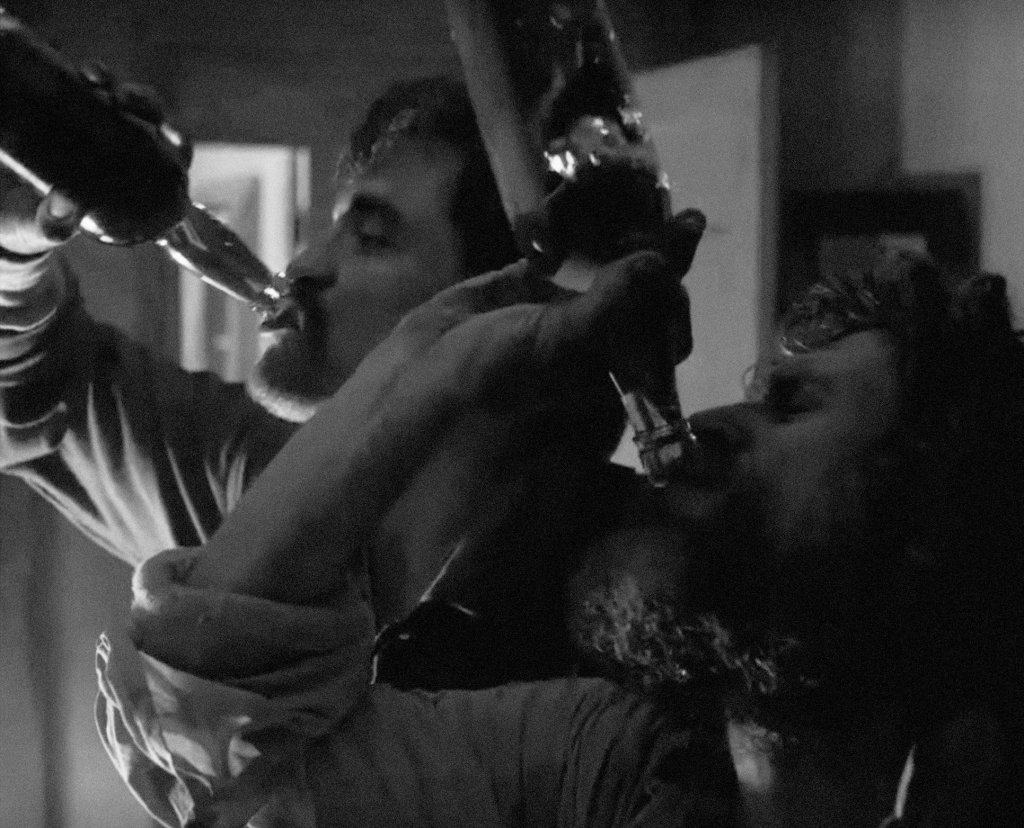
The excessive drinking between the two reflects the chaotic nature of the storm and also the increasingly chaotic state of both the characters headspace.
Winslow is not only struggling with isolation but also alcoholism that is controlled by Wakes frequent encouragement of it, throughout the film Wake and Winslow drink together with this being the only time that the two of them seem to be amicable with each other, which is shown by the Winslow quote ‘You’re only tolerable when you’re drunk’. The drink seemingly voids the power struggle between the two as both of them are occupied so they do not direct their emotional stress onto each other. However Winslow later finds out this is so Wake can claim that Winslow has been insubordinate and thus is less qualified to be the light keeper, which results in the final conflict between the two characters in which Winslow overpowers Wake and makes him walk on a leash and bark (which is a callback to earlier in the film when Wake calls Winslow a ‘dog’). He does this before burying Wake alive and killing him, when it seems Wake dies Winslow stops for a moment and rushes to Wake, seemingly a human moment from the young lighthouse keeper however he goes straight for the keys that access the top of the lighthouse showing that he is a man who has totally lost his humanity in pursuit of an identity and is responsible for the deaths of two men in his persuit of meaning. Winslow witnesses a corpse in the water which he and naturally the audience is lead to belief is that of the former assistant lighthouse keeper however due to him being the only one who hallucinates within the film and him not being a reliable narrator it seems likely that this is the guilt he feels for his part in the death of a co-worker at his previous job, as the guilt clearly affects him hence why he ran away from it and towards solitude in the lighthouse and why he ‘spilled the beans’ to Wick, it’s more likely to be a hallucination thats fueled by isolation and guilt.
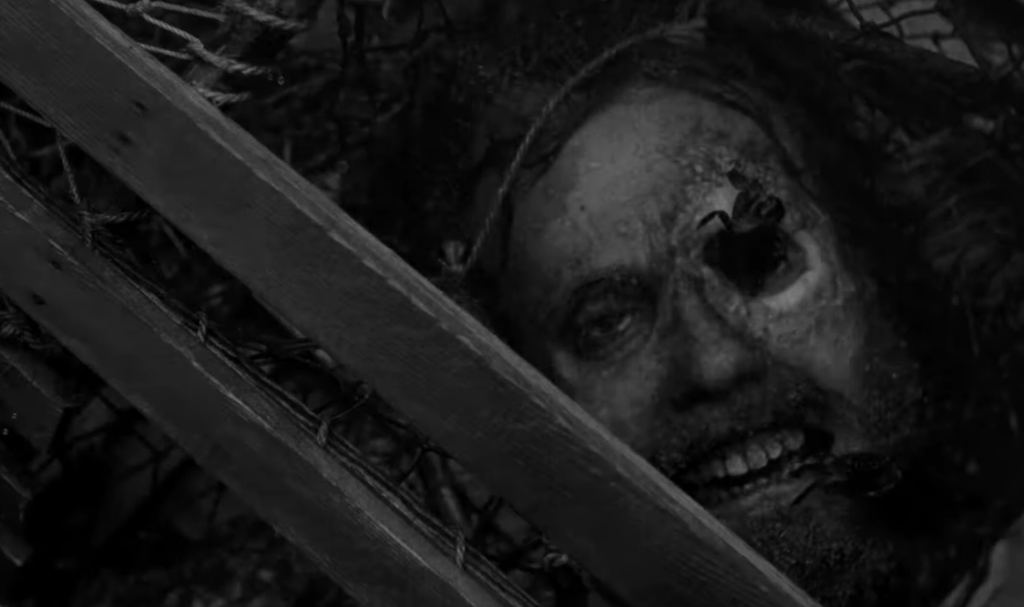
Winslow being the only one seeing the corpse reflects how the vision is personal to him.
The corpse that Winslow found has further significance than this however, as it resembles the seagull that mocks Winslow earlier on in the film in the sense that the two of them only have one eye, which means there is a clear connection between the two. Winslow attempts to dismiss the two of these things as he tries to dismiss his own guilt and much like in Macbeth the guilt experienced is manifested through a hallucination, with him killing the seagull and believing the corpse to be the fault of Wake. The fact that the two of them only have one eye is most likely due to how the guilt has taken a piece of himself away from him and how he will never be able to recover it, which is only reinforced by the fact that he is a man completely left alone with his thoughts. When he does ‘spill the beans’ to Wake, Wake dismisses it and discourages him from disclosing any major information. When Winslow eventually kills Wake and enters the light floor of the lighthouse he realises that he had not received the answer he was looking for, his obsession with being the light keeper and the responsibility and purpose that came with it was a lie, and so the final scene shows Winslow being eaten alive by seagulls, with one eye missing a reference back to the corpse and seagull that both had one eye, reinforcing the notion that they represent guilt and how bits of him have been lost. It seems that Winslow did not actually die but rather the final shot just showcases how he did not find the answers he was looking for and now had even more reason to feel guilt, hence why not only was his eye missing but other parts of his body were being picked away by the seagulls. Winslow falling down the stairs after seeing the light in the film seems to be more like a dawning realization than a literal fall as he realises how isolation has completely corrupted him.
Ultimately the force that drives Winslow mad is not that of the supernatural but rather the power of isolation this is shown by the fact that neither Winslow or Wake’s hair length changes despite the large amount of time that has supposedly past in the film as intense isolation is known to have a profound impact on the conceptions of time this is shown by an experiment carried out in in which a woman named Stefania Follini was placed in an isolation bunker and believed she was underground for just half as long as she actually was. Wick had clearly been affected by years alone in the lighthouse so much so that he saw Winslow as a threat and attempted to constantly berate and control him, Winslow’s emancipation from Wake failed in finding himself an identity and escape from boredom, he was a man driven to madness by isolation and pushed by a man who was also driven mad by isolation. Due to this it is safe to say that Winslow is not a reliable narrator and so the supernatural elements he encounters shouldn’t be taken literally.
Bibliography
Oakland, Calif – 2011 – Tortured By Solitude – New York Times – November 5th 2011
Joho, Jess – 2019 – What the hell does ‘The Lighthouse’ even mean? – Mashable – October 21st 2019
Webb, Jonathon – 2014 – Do people choose pain over boredom – BBC News – 4th July 2014
Cohen, Deborah – 2013 – Why does being lonely makes you ill? – BBC News – 23rd February 2013
Francis Mccullagh, John – 2019 – Choosing Aspect Ratio: A Guide to Everything You Need to Know – The Beat – June 25th 2019
Vsauce – Isolation – Mind Field (Ep 1) – Online Video Clip – YouTube – January 18th 2017 – 12th January 2020
Films referenced
The Lighthouse, Robert Eggers, 2019, A24 Productions.
The Witch, Robert Eggers, 2015, A24 Productions
 s5214978